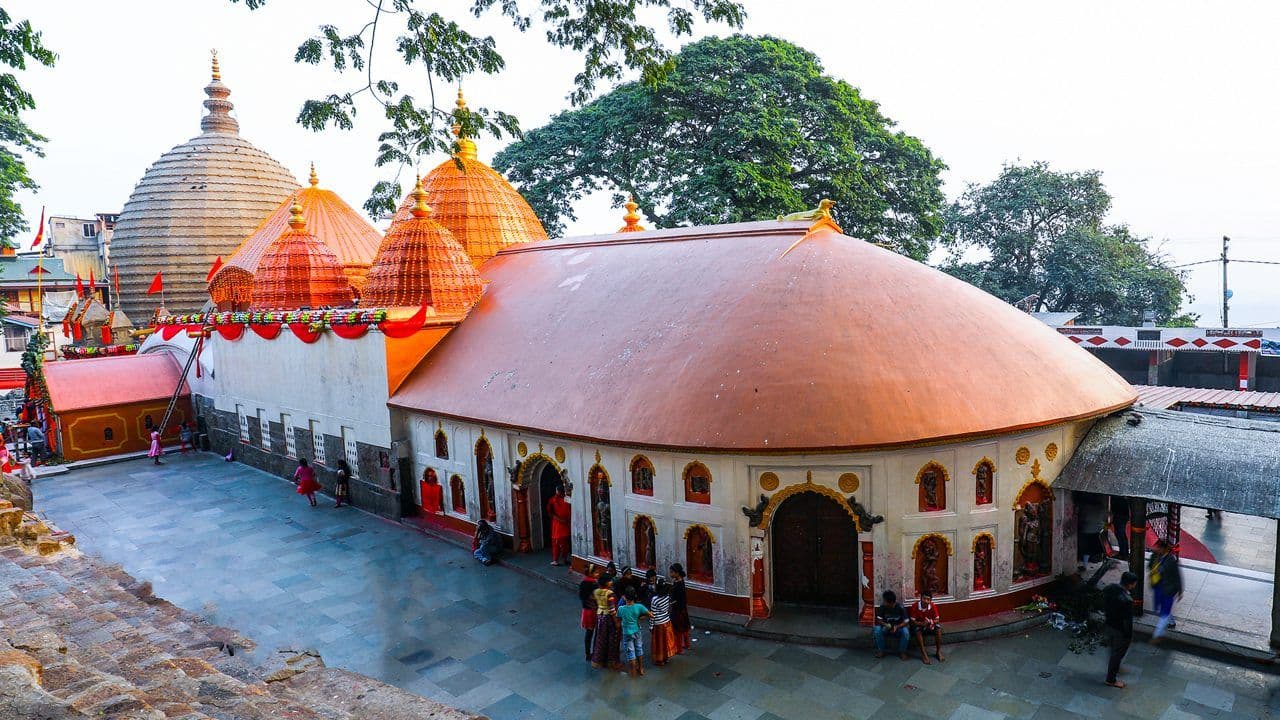
GUWAHATI — Groundwork for the ₹498.37-crore Maa Kamakhya Temple Access Corridor has begun on Nilachal Hill, with authorities relocating businesses and dismantling structures falling within the project alignment as the Assam government moves ahead with its long-planned redevelopment of the temple approach.
The project, sanctioned under the Centre's Prime Minister's Development Initiative for North Eastern Region (PM-DevINE), was approved at a cost of ₹498.37 crore and is intended to improve access to the Kamakhya temple, ease congestion and provide upgraded facilities for pilgrims. The foundation stone for the project, also known as the Maa Kamakhya Divya Lok Pariyojana, was laid by Prime Minister Narendra Modi in March 2024.
On-ground construction activity began in July, following preliminary work and the relocation of establishments located within the corridor area. Officials said around 15 families within the alignment zone would require temporary relocation. Shops and other structures along the approach have also been removed as work gets underway.
The project had faced legal challenges over its potential impact on the historic temple complex, the Nilachal Hill landscape and the network of underground springs regarded as sacred by devotees.
In February 2026, the Gauhati High Court cleared the way for the state government to proceed with the project. The court was hearing a public interest litigation and a separate writ petition that had raised concerns about possible damage to the temple, the Dasamahavidya shrines, natural caves and underground water springs. The petitioners had also questioned whether construction could proceed without the necessary heritage and archaeological safeguards.
The court ultimately found no embargo on the project proceeding, while noting assurances that construction would not damage the underground holy springs or the protected features of Nilachal Hill. The legal proceedings had also brought attention to the fact that while the Kamakhya temple itself has not been declared a monument of national importance under the central heritage law, several archaeological features on Nilachal Hill are protected.
The Archaeological Survey of India's Guwahati Circle lists several protected archaeological features around Nilachal Hill, including rock-cut images of Ganesha, Shiva lingas, Bhairavi and Dancing Bhairava, miniature shrine carvings and a historic stone gateway. Some of these features date to approximately the 11th and 12th centuries, while the stone gateway is associated with the Koch period.
Heritage concerns have therefore remained a central issue surrounding the corridor. The legal proceedings included demands for detailed hydrological, ecological and structural studies before construction, particularly because of the presence of underground springs and other natural features considered integral to the religious character of the hill. A hydrological study was previously proposed amid concerns that construction could affect the underground water system.
The National Monuments Authority has also considered permission for construction within the prohibited area around protected heritage features on Nilachal Hill. Its recommendation for a visitor facilitation centre included conditions requiring the work to be carried out under the supervision of the ASI's Superintending Archaeologist and in accordance with the applicable building regulations.
The Assam government has defended the corridor as an infrastructure and pilgrimage-management project rather than a redevelopment of the historic shrine itself. The stated objective is to improve pedestrian movement, reduce congestion and provide better facilities for the large number of devotees visiting Kamakhya, particularly during major religious gatherings such as the annual Ambubachi Mela.
The scale of the project has also made its impact on local businesses and residents an immediate issue. With shops being relocated and structures dismantled along the proposed alignment, the redevelopment is now moving from years of planning and litigation into its construction phase.
For the government, the corridor is a major religious-tourism project intended to transform access to one of Assam's most important pilgrimage sites. For conservationists and local stakeholders, the challenge now is ensuring that the infrastructure expansion does not compromise the archaeological, ecological and religious character of Nilachal Hill.
With construction underway, that balance is likely to remain at the centre of scrutiny as the ₹498-crore project progresses.