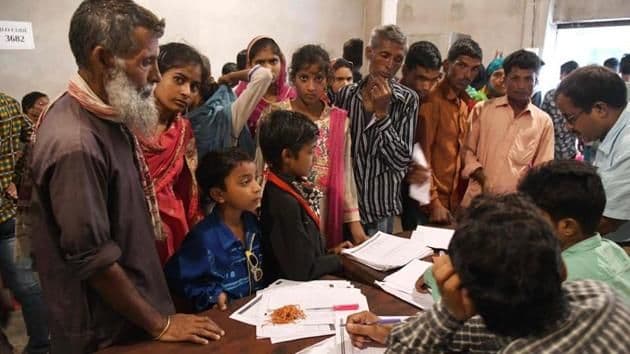
GUWAHATI — Nearly seven years after Assam's final National Register of Citizens (NRC) was published, the citizenship exercise remains incomplete, with the formal process for issuing identity cards to those included and allowing excluded applicants to appeal yet to be completed.
The final NRC was published on August 31, 2019, with 3.11 crore people included and approximately 19.06 lakh applicants left out. But the publication of the list did not bring the process to a legal conclusion. A petition now before the Supreme Court has sought directions to the Centre to complete the remaining statutory steps, including issuing identity cards to those included in the register and beginning the appeals process for those excluded.
The Supreme Court has taken notice of the plea filed by the Assam State Jamiat Ulama, with the petition arguing that publication of the NRC represented only part of the exercise mandated under the applicable legal framework. Seven years after the list was released, the absence of the promised identity cards and a functioning exclusion-appeal mechanism has left the status of the exercise uncertain.
The NRC's official website continues to provide access to the final results, while the Assam government's Home and Political Department lists the final NRC among its official resources. The government page was last reviewed in July 2026.
At the same time, citizenship disputes connected to Assam's broader foreigners-detection system continue to reach the courts.
In July, the Supreme Court set aside decisions involving 27 Assam residents who had previously been declared foreigners by Foreigners Tribunals and whose cases had subsequently been upheld by the Gauhati High Court. The court ordered fresh adjudication, stressing that citizenship and foreigner-status determinations must follow a fair, lawful and reasonable procedure.
The cases included allegations that some applicants had been declared foreigners because of procedural or documentary discrepancies, including differences in names recorded in old electoral rolls. The Supreme Court made clear that sending the cases back for fresh hearings did not establish the applicants as Indian citizens; rather, it required the citizenship question to be determined through a proper adjudicatory process.
The ruling has renewed attention on the workings of Assam's Foreigners Tribunals, where individuals suspected of being foreigners are required to establish that they are Indian citizens. The Gauhati High Court has continued to hear challenges to tribunal decisions, including cases involving people who were declared foreigners years earlier.
In one case decided in June, the Gauhati High Court examined a petition challenging a Foreigners Tribunal decision that had declared an Assam resident a foreigner on the basis that he had failed to establish a link to Indian ancestors before March 25, 1971, the cut-off date applicable under Section 6A of the Citizenship Act.
Another recent Gauhati High Court case involved a Goalpara resident who produced 16 documents and his father as a witness but was nevertheless declared a foreigner. The case has drawn attention from legal observers to the evidentiary burden placed on people appearing before Foreigners Tribunals.
The Supreme Court's July intervention has also highlighted the consequences of proceedings conducted without a full opportunity for the person concerned to participate. In ordering fresh hearings for the 27 appellants, the court said the serious consequences of being declared a foreigner must follow an adjudication that satisfies the requirements of the Foreigners Act, the Foreigners (Tribunals) Order and constitutional standards of fairness.
The developments underscore the distinction between the NRC and the Foreigners Tribunal system. The NRC was an exercise to prepare a register of Indian citizens in Assam, while Foreigners Tribunals determine individual references concerning whether a person is a foreigner under the applicable law. NRC exclusion does not, by itself, amount to a declaration by a Foreigners Tribunal that an individual is a foreign national.
For Assam, the result is a citizenship process that remains unresolved on several fronts. The NRC list has been published, but its remaining statutory procedures have not been completed, while individual citizenship disputes continue to move through the Foreigners Tribunals, the Gauhati High Court and the Supreme Court.
Seven years after the final list was released, the central question is therefore no longer simply who was included or excluded from the NRC. It is how, and through what legal process, the citizenship status of those affected will ultimately be settled.